

.png)
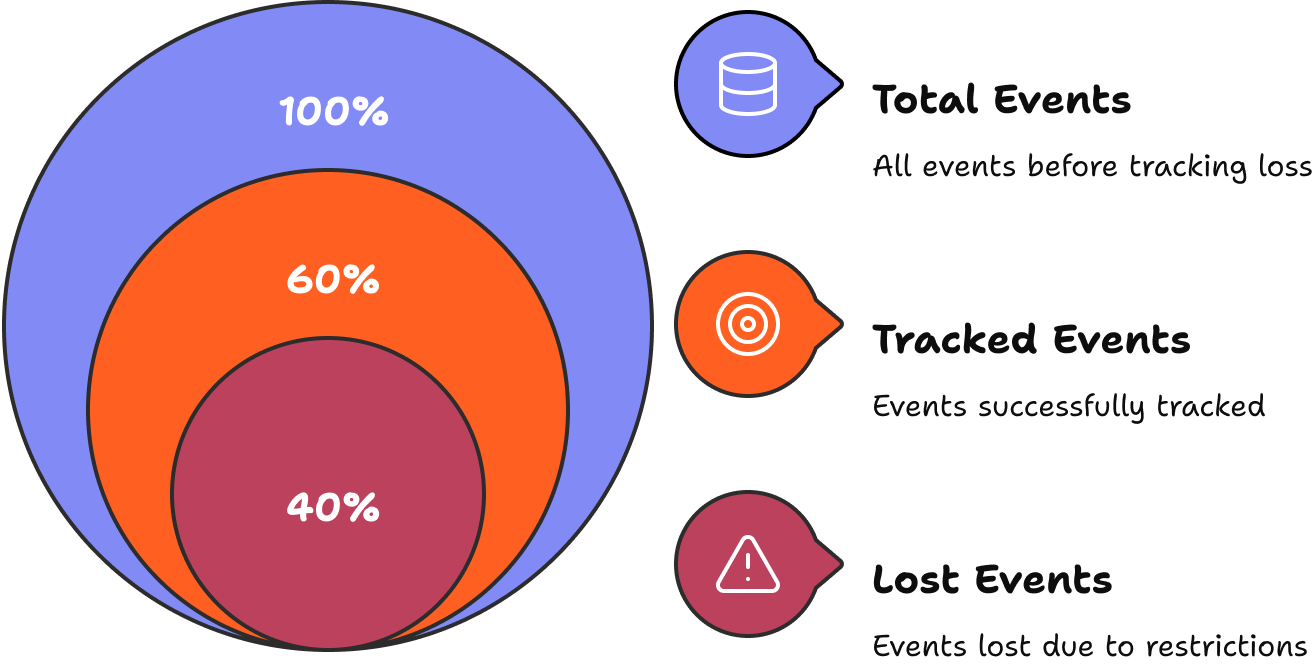
TL;DR: Having server-side tracking and having it work correctly are two different things. Most setups still drop events when browser tracking fails, meaning platforms learn from 60% of your data. Missing events skew algorithms toward low-privacy, lower-value customers. EdgeTag maintains persistent server-side connections that capture every conversion regardless of browser behavior. An H&W DTC Brand cut Meta CAC 10-20% just from giving platforms complete data.
Your Meta ROAS looks healthy at 3.2x, but here's what you don't see: The platform is only learning from 60% of your actual events!
The other 40%? Lost to iOS restrictions, ad blockers, and browser privacy settings. And those missing events aren't random—they're often your highest-value customers who care most about privacy. This isn't just a reporting problem. It's an algorithm training disaster.
The Server-Side Tracking Paradox
Most performance marketers already know they need server-side tracking. You've probably implemented it months ago, checked the box, and moved on. But here's the uncomfortable truth: having server-side tracking and having it work correctly are two vastly different things.
The typical setup captures some server-side events, sure. But when browser-side tracking fails, which happens constantly with Safari's ITP((Intelligent Tracking Prevention), Firefox's ETP(Enhanced Tracking Protection), and privacy-conscious customers using ad blockers, your server-side implementation doesn't automatically pick up the slack. Those events simply vanish from your platform's view.
Think about what this means for your campaigns. Meta's algorithm is making bid decisions based on incomplete data. Google's Smart Bidding is optimizing toward a biased subset of your customers. TikTok's targeting is learning from patterns that don't represent your full audience. You're essentially training these platforms' AI on a distorted version of reality.
Beyond Implementation: The EdgeTag Approach
EdgeTag doesn't just add another tracking layer—it fundamentally reimagines how event data flows to your ad platforms. When browser-side tracking fails, EdgeTag's server-side infrastructure immediately takes over, ensuring every conversion reaches Meta, Google, TikTok, Snapchat, and Pinterest. No gaps. No guesswork.
The technical difference matters. Traditional server-side setups often rely on conditional logic: "If browser tracking fails, then try server-side." This creates latency and decision points where data can slip through. EdgeTag operates differently, maintaining persistent server-side connections that capture and relay every event regardless of browser behavior.
The Compound Effect on Campaign Performance
When platforms see 100% of your events instead of 60%, the impact compounds quickly. Algorithms learn faster and more accurately. Lookalike audiences actually look like your real customers, not just the subset willing to accept cookies. Bid strategies optimize toward true ROAS, not the inflated metrics you see when only low-value events are tracked.
An H&W DTC Brand saw their Meta CAC efficiency improved by 10-20% within weeks of implementing proper server-side tracking—not from better creative or targeting, but simply from giving the algorithm complete data to work with. The platform could finally see what was already happening.
The Takeaway
Stop asking "Do we have server-side tracking?" Start asking "Are we capturing every conversion when browser tracking fails?" The difference between these questions could be 40% of your conversion data—and the difference between algorithms that work for you versus against you.
Your ad platforms are only as smart as the data you feed them. Make sure they're getting the full picture. Ready to see exactly how much conversion data you're missing?
Book a demo → to get a complete understanding of your tracking infrastructure.