

TL;DR: If ROAS looks fine but new customer growth is stalling, platforms are over-delivering repeat buyers because they can't distinguish new from returning. EdgeTag fixes this by labeling Purchase_NC and Purchase_RC events using real CRM history, not cookies, and firing separate First Click and Last Click events so prospecting channels get accurate credit. One supplement brand saw 65% more new customers on Google and 31% on Meta without touching creative or bids.
Brands fixing NC vs RC optimization at the signal layer see 30-65% new customer growth within 90 days. Not from creative refreshes or audience hacks but from finally giving platforms the lifecycle truth they need to stop over-delivering repeat buyers.
You already know what it looks like: ROAS looks stable while new customer volume stalls. Prospecting budgets keep finding familiar buyers. Platform dashboards claim success while your CRM shows acquisition efficiency eroding.
The issue isn't your media strategy. It's that platforms are optimizing without reliable lifecycle signals. When they can't see who's new vs returning, they default to the easiest conversions which are. in most-cases, the repeat customers.
Here's how to fix it.
Why NC vs RC Optimization Breaks?
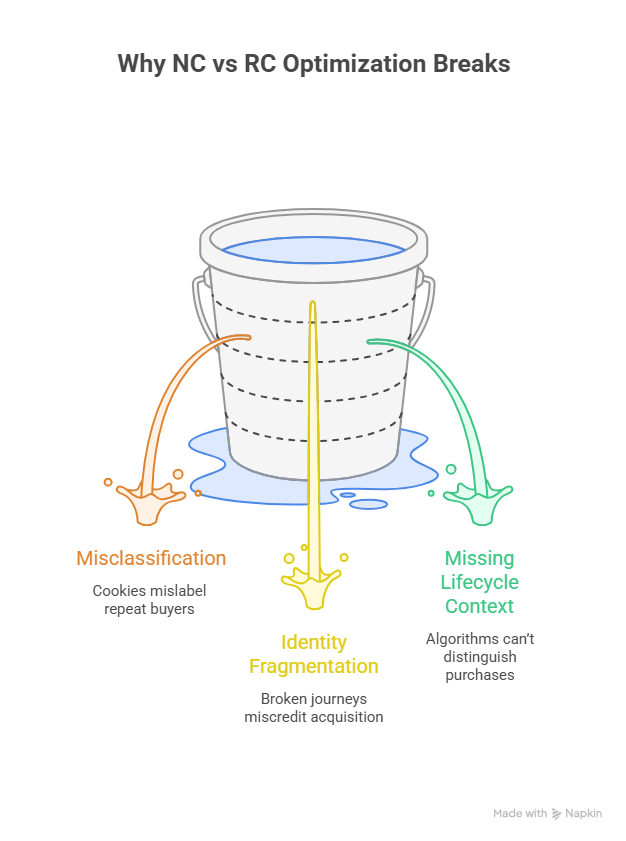
Three data gaps cause platforms to over-deliver repeat customers:
1. Misclassification
Cookie-based tracking counts device switches and guest checkouts as "new" customers, inflating acquisition metrics while hiding repeat-heavy delivery.
2. Identity fragmentation
Without persistent first-party IDs, customer journeys break across mobile, desktop, and email. Acquisition channels get under-credited while retargeting gets over-rewarded.
3. Missing lifecycle context
Purchase events arrive without is_new_customer flags or order history. To the algorithm, a first purchase looks identical to a fifth purchase, so it optimizes toward whoever converts fastest.
Native platform features like Google's New Customer Acquisition goals and Meta's audience controls can't fix this—they depend on accurate input data. When lifecycle truth is missing, they filter rather than optimize.
The result is an optimization bias that quietly redirects spend toward existing customers while making prospecting look inefficient. Performance inside platform dashboards appears strong while incremental growth stalls.
How EdgeTag Fixes NC vs RC Optimization
EdgeTag restores lifecycle truth at the infrastructure layer by capturing first-party signals at the CDN edge and delivering enriched events platforms can actually optimize on.
NC vs RC event separation platforms can train on
EdgeTag labels purchases based on real CRM purchase history—not cookies or device IDs. First-time buyers trigger Purchase_NC events. Returning customers trigger Purchase_RC events. This distinction holds across devices, browsers, and sessions because of unified first-party identity.
What changes: Platforms stop guessing from fragmented signals and receive explicit lifecycle labels. Bidding trains on first-time buyers instead of blended conversions. Lookalike audiences improve because they seed from true new customers, not misclassified repeat buyers.
First Click vs Last Click clarity for channel truth
This is the unlock most teams don't realize they're missing. Even when you can label NC vs RC, you still need to know which channels created the customer versus which ones closed the sale.
EdgeTag fires separate First Click and Last Click purchase events:
- First Click shows which channel introduced the customer
- Last Click shows which channel captured the conversion
What changes: Prospecting channels stop looking inefficient just because they lack last-touch credit. Upper-funnel spend gets credited for customer creation, not just assist roles. Budget allocation shifts from "what closed the sale" to "what grew the customer base."
This immediately changes budget conversations. Channels that introduce customers finally get accurate credit, while channels that harvest existing demand stop getting over-rewarded. Teams can prove which placements drive true acquisition instead of relying on blended last-click attribution.
Low-code setup, not a rebuild
NC/RC logic, event enrichment, and routing live in the EdgeTag dashboard—not in repeated code releases. Most brands deploy across Shopify, WooCommerce, BigCommerce, or custom stacks in hours, not weeks.
The infrastructure fix happens at the edge, so privacy controls, consent handling, and audit trails sit in a single layer. Teams can adjust lifecycle rules, suppress events, or enrich signals without engineering releases.
Proof: What Happens When Platforms Can See New Customers
One supplement brand hit the classic wall: platform performance looked strong, but new customer growth had stalled due to misclassification and weak attribution.
After implementing EdgeTag to restore lifecycle signals and attribution clarity:
Google Ads: +65% new customers (2,857 vs 1,725 YoY)
Meta: +31% new customers, +34% orders during profitable scale
Overall: +40% total orders
The Takeaway
The gains came from fixing the signal layer, not from creative testing or bid changes.
Full breakdown →
When platforms can reliably distinguish new from returning customers, acquisition spend optimizes toward business growth instead of recycled demand. Bidding algorithms train on the right outcomes. Attribution becomes honest. And budget allocation reflects actual customer creation rather than last-touch credit games.
Fix It Fast
If new customer share is declining while ROAS looks healthy, or if platform-reported new customers don't match CRM truth, you're dealing with signal loss and identity fragmentation and not a media problem.
New to EdgeTag?
Request a signal loss analysis to identify where your stack is misclassifying customers and losing attribution clarity. Or start implementing now with the getting started guide, then configure NC vs RC optimization to restore lifecycle signals.
Already on EdgeTag?
Follow the NC/RC optimization setup guide to configure Purchase_NC and Purchase_RC events with First Click attribution.