

TL;DR: Modern DTC brands run complex multi-tool ecosystems but tracking infrastructure hasn't kept up. Every platform update breaks integrations and creates attribution gaps. EdgeTag replaces brittle point-to-point connections with a unified data layer that auto-updates when platforms change. One brand discovered they were under-attributing conversions by 31%, not from poor performance but from broken integrations.
You've invested $200K annually in your marketing stack—Shopify Plus, Klaviyo, Triple Whale, Gorgias, plus that new AI personalization tool everyone's raving about.
But here's the painful irony: These tools cannot efficiently communicate with each other because your tracking infrastructure wasn't built for a modern, multi-tool ecosystem.
Every time Meta updates their Conversions API, your developer spends three days fixing broken integrations. When you test a new funnel builder like Replo or CartFunnels, tracking becomes a month-long engineering project. And that promising Checkout Champ implementation? It's still sending partial data six weeks later.
The Integration Sprawl Reality
Today's successful DTC brands don't run on single platform, but run on ecosystems. Your customers might discover you through TikTok, browse on Webflow, abandon cart in Fermat, and finally convert through a Funnelish upsell flow. Meanwhile, your retention stack spans Klaviyo, Postscript, and Yotpo, while analytics flow through Triple Whale, Northbeam, and GA4.
The traditional approach? Custom scripts, webhook gymnastics, and prayers. You hire contractors to write JavaScript bridges between platforms. You maintain spreadsheets tracking which integrations work, which are partially broken, and which are completely dead. Your attribution data has more gaps than Swiss cheese because each tool captures different events differently.
This isn't sustainable. Moresoever, not at all necessary.
Beyond Point-to-Point Connections
EdgeTag takes a fundamentally different approach to integration architecture. Instead of building brittle point-to-point connections between each tool, it creates a unified data layer that speaks every platform's language natively.
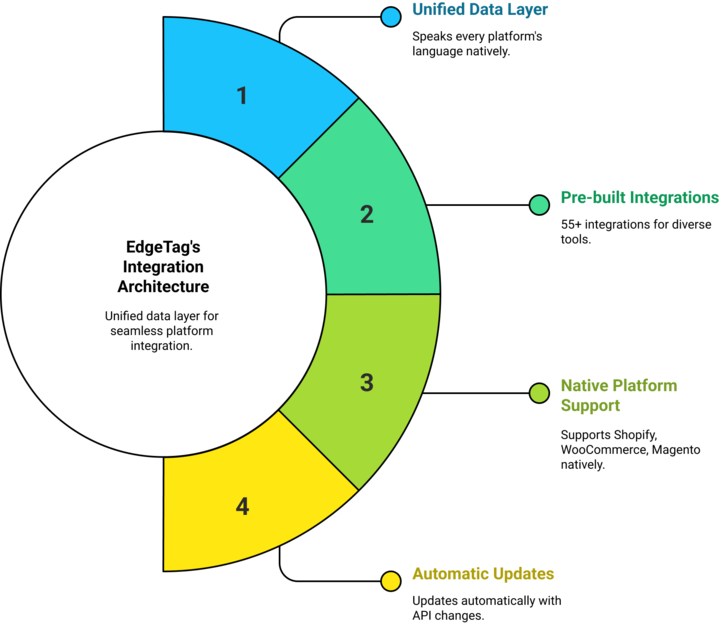
With 55+ pre-built integrations spanning ad platforms, funnel builders, analytics tools, and retention marketing systems, EdgeTag eliminates the integration tax you're currently paying. Native support for Shopify, WooCommerce, and Magento is just the starting point.
Every major funnel service connects without custom code: Webflow, Checkout Champ, Fermat, Replo, Funnelish, CartRush, & more.
The technical advantage runs deeper than plug-and-play simplicity. When Meta adjusts their Conversions API requirements (which happens quarterly), EdgeTag's integration updates automatically. When TikTok releases Events API 2.0, your tracking continues uninterrupted while competitors scramble to read documentation and deploy fixes.
The Compound Value of Unified Infrastructure
Consider what happens when your entire stack shares the same tracking foundation. That customer journey from TikTok ad to Webflow landing page to Funnelish checkout to Klaviyo retention flow? Every touchpoint is captured, attributed, and synchronized. Your Meta algorithm learns from Fermat funnel behaviors. Your Google Smart Bidding optimizes based on actual lifetime value from your retention tools.
One brand running multiple funnel tools discovered they were under-attributing conversions by 31% simply because their checkout platform wasn't properly passing data back to ad platforms. After implementing proper unified tracking, their reported ROAS increased overnight—not from better performance, but from finally seeing performance that was already there.
The Takeaway
Your marketing stack's potential is limited by its weakest integration. Stop accepting broken tracking as the cost of innovation. Stop treating platform updates like emergency fire drills.
EdgeTag ensures every tool in your arsenal works together seamlessly, with tracking that adapts automatically to platform changes. Want to see how your current integration setup is limiting your growth?
Book a demo → to audit your tech stack's tracking gaps and discover what unified infrastructure actually looks like.